
Choosing a Cook Islands Trustee Company - What to Look For
How to evaluate a Cook Islands trustee - licensing, U.S. client experience, financial stability, responsiveness, and the red flags to avoid.
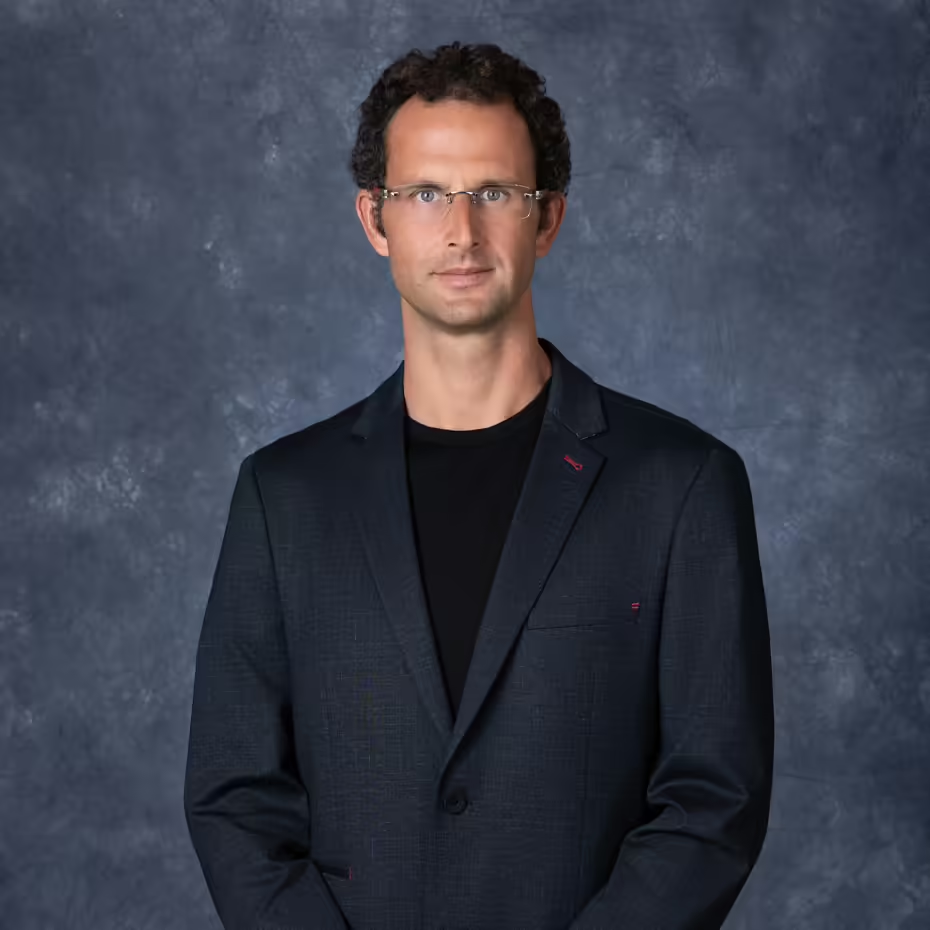 Attorney Blake Harris· Florida Bar #86486, Colorado Bar #45942
How do you choose a Cook Islands trustee?
A Cook Islands trustee is the licensed Cook Islands corporation that holds legal title to your trust assets and is responsible for enforcing the trust against creditor claims.
Choosing one comes down to seven criteria: regulatory licensing with the Cook Islands Financial Supervisory Commission, capitalization, professional indemnity insurance, ownership transparency, working relationships with U.S. asset-protection attorneys, asset-protection track record, and responsiveness on settlor communications.
Introduction
The trustee is the most important party in a Cook Islands Trust. They hold your assets. They are the entity that must stand firm when a creditor attacks. Their judgment, their financial stability, their experience, and their willingness to exercise independent control in a crisis are the difference between a trust that holds and one that collapses.
Choosing a trustee is not a formality. This article tells you what to look for, what questions to ask, and what red flags to avoid.
Why the Trustee Selection Matters So Much
In most legal structures, the parties you choose affect convenience and cost. With a Cook Islands Trust, the trustee choice affects whether your assets are actually protected.
Here is why:
The trustee must be beyond U.S. jurisdiction. The entire protection mechanism depends on the trustee being a foreign entity that a U.S. court cannot compel. A poorly structured, undercapitalized, or compromised trustee undermines that independence.
The trustee may need to act unilaterally in a crisis. When a duress condition is triggered, the trustee must exercise independent discretionary control - ignoring the settlor's instructions, refusing foreign court orders, and protecting assets under Cook Islands law. A trustee that lacks the experience, the institutional resolve, or the legal capacity to do this is not providing real protection.
You are handing this entity your assets. The trustee holds legal title to your wealth. Their integrity, their solvency, and their professional obligations must be beyond question.
Licensing Requirement: Non-Negotiable Starting Point
Cook Islands law requires that the trustee of a Cook Islands International Trust be licensed by the Cook Islands Financial Supervisory Commission (FSC). This is not optional.
Under the Trustee Companies Act 2014, carrying on trustee company business in the Cook Islands without a license is an offense, and the FSC states that only licensed trustee companies are able to register international entities. A provider that is not on the FSC's list of licensed trustee companies cannot register your trust as a Cook Islands international trust.
Before anything else, confirm that any trustee you are considering holds a current, valid license from the Cook Islands Financial Supervisory Commission. Your attorney should be able to confirm this directly.
Key Criteria for Evaluating a Cook Islands Trustee
1. Operating History and Tenure
How long has a trustee company been operating? It's a reasonable starting point - but it's not the whole picture.
Tenure doesn't guarantee competence. There are trustee companies with decades on their website and a track record of slow communication, opaque reporting, and clients who can't get a straight answer when it matters. A long history tells you a company has survived. It doesn't tell you how they treat clients.
What actually matters is how responsive and transparent a trustee is - especially under pressure. Can you reach them when something urgent comes up? Do they communicate clearly, or do you get vague updates and long delays? Do they explain what's happening with your trust, or do you have to chase them for answers?
Atlas Trust Company was purpose-built around exactly those standards. Every process, every client interaction, every reporting structure was designed from the ground up with responsiveness and transparency as the baseline - not an afterthought added onto a decades-old operation.
Look for a trustee that answers your questions clearly and quickly, keeps you informed, and operates like a partner - not a gatekeeper.
2. Experience with U.S. Clients
Cook Islands trustees serve clients from many countries. Not all of them have deep experience with U.S.-specific issues: IRS reporting coordination, U.S. fraudulent transfer challenges, U.S. court orders, and the specific dynamics of U.S. creditor attacks.
A trustee experienced with U.S. clients will understand the Form 3520/3520-A reporting requirements, will have existing relationships with U.S. attorneys, and will have encountered the full range of U.S. creditor tactics.
Look for: A trustee with a demonstrated U.S. client base and experience working alongside U.S. asset protection attorneys.
3. Financial Stability
The trustee holds your assets in custody. Their financial health matters. An insolvent or financially distressed trustee creates risk - not because they could steal your assets (that is covered by fiduciary law and criminal liability), but because financial distress can disrupt the trust's administration and create operational problems at the worst possible time.
Look for: A trustee that can provide some evidence of financial stability - professional indemnity insurance, regulated capital requirements under Cook Islands FSC rules, and a long operating history (which itself is an indirect indicator of solvency).
4. Professional Staff and Infrastructure
Who actually runs the trust on a day-to-day basis? A trustee that is run by a small team with high turnover is a different proposition than one with a stable team of experienced trust administrators.
In an emergency, you need the trustee to respond quickly, make sound legal judgments, and coordinate with Cook Islands counsel. That requires people who know what they are doing and have done it before.
Look for: Experienced, stable trust administration staff; evidence of legal counsel availability; clear escalation procedures for crisis situations.
5. Communication and Responsiveness
You will communicate with your trustee regularly - to provide Letters of Wishes updates, to request distributions, to update beneficiary information, to coordinate annual reporting. In a crisis, you may need to communicate with them urgently.
A trustee that is difficult to reach, slow to respond, or communicates poorly is a problem during ordinary administration and a serious problem in an emergency.
Look for: A clear point of contact, responsiveness to inquiries, and a demonstrated willingness to communicate proactively. Ask directly how they handle urgent communications and what their response time commitments are.
6. Fee Structure Transparency
Trustee fees should be disclosed clearly and in writing before you engage. There should be no surprise fees or unclear billing.
Ask for:
- The annual administration fee (flat or hourly)
- Fees for specific transactions (distributions, responding to legal matters, replacing accounts)
- Fee escalation terms - what happens to fees over time?
- How fees are billed and when payment is due
Red flag: A trustee that is vague about fees or that offers unusually low fees without a clear explanation. Low fees often mean either thin margins (financial vulnerability) or inadequate service levels.
7. Your Attorney's Relationship with the Trustee
This matters more than most clients realize. When your attorney has an established working relationship with a trustee - when they have worked together on multiple structures, when the trustee knows the attorney's standards, when communication channels are already established - the setup process is faster and the ongoing administration is smoother.
In a crisis, the relationship between your U.S. attorney and the Cook Islands trustee is the coordination channel through which your protection is exercised. A warm relationship, with established trust and communication protocols, functions better than a cold introduction made under pressure.
Look for: Your U.S. attorney's recommendation based on their direct experience. This is one area where your attorney's network should carry significant weight.
Red Flags: What to Avoid
Unlicensed trustees. A provider that is not on the FSC's list cannot register a Cook Islands international trust - a common hallmark of discount trust providers that are not law firms.
Trustees promoted by non-attorney salespeople. Be very cautious about any trustee that reaches you through an offshore promoter, wealth preservation seminar, or non-attorney sales channel. These arrangements are often driven by referral fees, not by what is right for your structure.
Opacity about fees, operations, or regulatory status. A legitimate, well-run trustee should be able to answer straightforward questions about their licensing, fees, experience, and staff. Evasiveness is a red flag.
Trustees that promise unusually strong results. The Cook Islands framework is strong. No trustee can guarantee any specific outcome in litigation. A trustee that makes extravagant promises about protection outcomes is overstating their authority and yours.
Trustees with no U.S. client experience. The nuances of U.S.-specific creditor tactics and reporting requirements require specific expertise. A trustee that primarily serves European or Asian clients may lack that expertise.
The Role of Your U.S. Attorney in Trustee Selection
Your U.S. attorney should take the lead in recommending and coordinating with the trustee. This is one of the primary reasons why working with an attorney experienced in offshore asset protection - rather than a generalist - matters so much.
An experienced offshore attorney will have working relationships with one or more established Cook Islands trustees. They will know the trustees' operations from the inside, will have navigated prior structures and creditor situations with them, and will be able to provide a recommendation based on your specific situation.
Do not select a trustee independently without your attorney's input. The attorney-trustee relationship is a critical operational element of the structure.
Atlas Trust Company
Blake Harris Law works with Atlas Trust Company, a licensed Cook Islands trustee co-founded by Blake Harris. This relationship gives our clients direct access to an experienced, U.S.-attorney-aligned trustee with deep knowledge of the specific nuances that arise in U.S. client structures.
Summary: What Good Trustee Selection Looks Like
- Licensed by the Cook Islands FSC - verified, not just claimed
- Demonstrated experience with U.S. clients and U.S. creditor attacks
- Financially stable; insured; regulated
- Experienced trust administration staff
- Responsive and communicative
- Clear, transparent fee structure
- Recommended by your U.S. attorney based on direct working experience
The trustee you choose is the entity that will actually protect your assets when it matters. Choose accordingly.
Frequently asked
Frequently asked questions
The Cook Islands has a small number of licensed trustee companies - the Financial Supervisory Commission's register listed ten on October 6, 2026. This is a deliberate feature of the regulatory framework; the FSC maintains standards that limit the field to qualified operators. You want one of the established, well-resourced trustees.
Yes. The trust deed should give the protector (or in some cases the settlor) the power to remove and replace the trustee. This is one reason the protector role is important.
Yes, provided the trustee is properly licensed and your attorney has vetted them. Meeting in person is not a practical requirement for most clients. The trustee's obligations are defined by Cook Islands law and the trust deed - legal obligations, not personal relationships.
Some structures use co-trustees. This is less common in Cook Islands Trust practice and can complicate decision-making during a crisis. A single experienced trustee is typically preferable.
The trust deed should include provisions for appointing a successor trustee if the current trustee becomes unable or unwilling to serve. The protector typically exercises this power. Cook Islands regulatory law also has provisions addressing insolvent or failed trustee companies. This is a scenario to plan for, not to ignore.
Your attorney can verify directly with the Cook Islands Financial Supervisory Commission. Do not rely solely on the trustee's own representation.
← All articleshttps://blakeharrislaw.com/articles/choosing-cook-islands-trustee